AVLA REAL ESTATE · LIVING IN GREECE · SCHOOLS AND EDUCATION 2026
Education in Greece 2026: Schools, Costs and Enrolment — A Guide for International Families
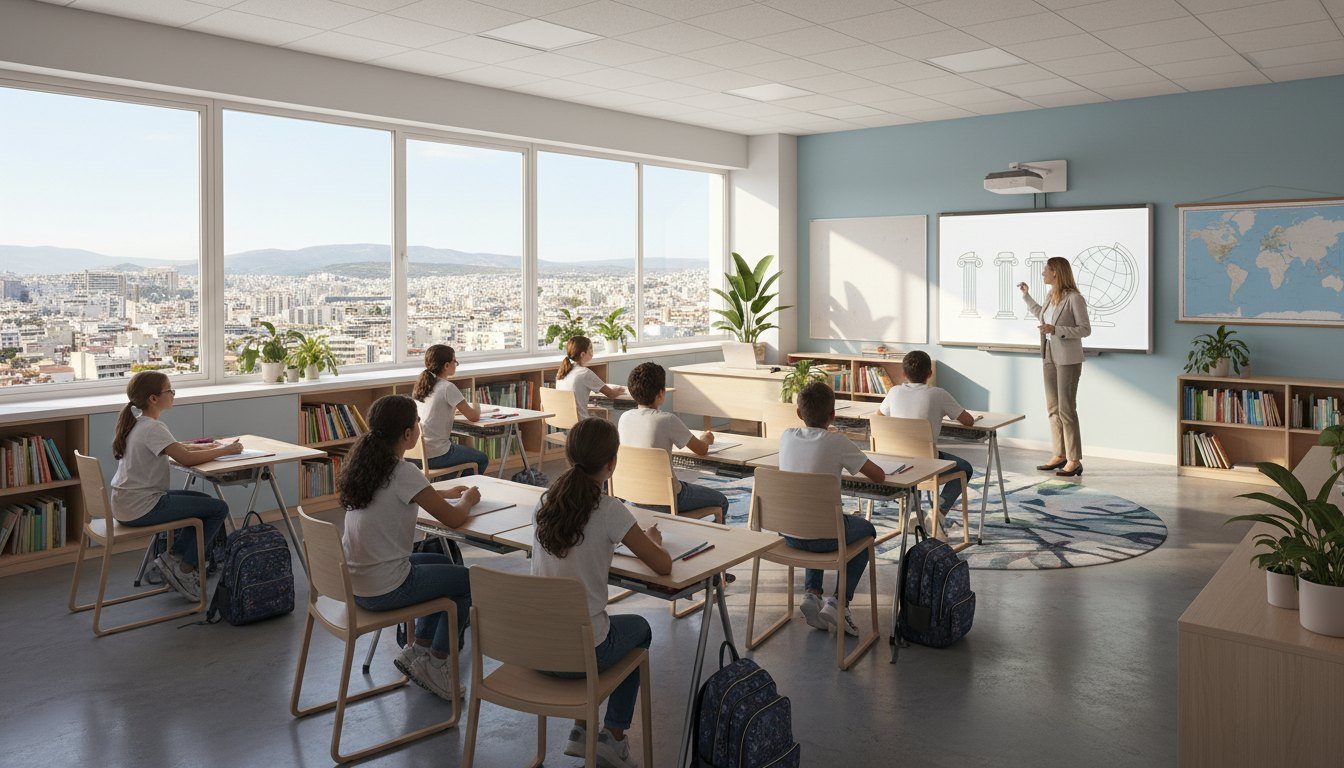
For most families, the Golden Visa decision is not settled by yield figures. It is settled by one question: what happens to the children? What will school cost, how fast will they adapt, and where does university lead? This guide answers those three questions with 2026 numbers and named sources.
How the Greek education system is structured
Compulsory schooling starts earlier than in most countries — kindergarten becomes compulsory at four — while upper secondary school is optional.
| Stage | Age | Duration | Compulsory? |
|---|---|---|---|
| Nipiagogeio (kindergarten) | 4-5 | 2 years | Yes |
| Dimotiko (primary) | 6-11 | 6 years | Yes |
| Gymnasio (lower secondary) | 12-14 | 3 years | Yes |
| Lykeio (upper secondary) | 15-17 | 3 years | No - optional |
Eleven years of compulsory education in total. Lykeio continues on an academic or vocational track, and university entry for domestic students runs through the national Panhellenic examinations — but foreign nationals have a separate quota route, covered below.
Three routes: public school, international school, Greek private school
A family relocating to Athens has three realistic options. The right answer depends less on budget than on the age of the child and how permanent the move is.
- Public school (free): Taught in Greek. For younger children — kindergarten to primary — this is usually the fastest route to integration, with the language settling within a year. For a child arriving at secondary age, the language load is a genuine risk that should not be underestimated.
- International school (EUR 6,120-16,500 published fees): Taught in English, French or German, following IB, British or American curricula. The most portable option for families who may later move on to a third country — the diploma travels.
- Greek private school with IB: Long-established schools such as Athens College, Pierce and Lampiri offer both Greek and IB tracks. A middle path for families planning to stay in Greece and wanting their children rooted in the local community.
International school fees in Athens (2026)
The International Schools Database lists 23 international schools in Athens, 12 of which publish their fees. The table below shows published annual ranges — the lower figure is kindergarten level, the upper figure secondary or IB.
| School | Annual fee (EUR) | Curriculum |
|---|---|---|
| Deutsche Schule Athen | 6,120 | German |
| Lycee Franco-Hellenique | 6,150 | French |
| DES Schools | 7,000 - 14,000 | IB |
| Byron College | 8,580 - 14,300 | British |
| International School of Athens | 8,700 - 15,000 | IB |
| ACS Athens | 9,050 - 16,348 | American + IB |
| Campion School | 9,200 - 15,650 | British + IB |
| St. Lawrence College | 9,369 - 15,204 | British |
| St. Catherine's British School | 9,710 - 16,500 | British + IB |
| Pierce - American College of Greece | 10,160 - 13,900 | Greek + IB |
| Athens College | 11,620 - 15,860 | IB |
| Lampiri School | 12,000 | Greek + IB |
The real surprise is in the extras. The figure on the school website is not the figure the family pays. Typical additional items, according to sector data:
- Enrolment / acceptance fee: EUR 1,000 - 3,500 (one-off)
- Application fee: EUR 100 - 400 (one-off)
- School bus: EUR 2,000 - 3,500 per year
- Meals: EUR 1,200 - 2,200 per year
- Capital / development levy: EUR 0 - 1,500 per year
- IB exam fees (grades 11-12): EUR 1,200 - 1,800
With extras included, the realistic total at a premium international school in Athens sits between EUR 17,000 and EUR 28,000 per child per year.
Enrolling in a public school: documents and timing
Children of residence permit holders enrol on equal terms with local pupils. The documents required:
- Birth certificate: officially translated into Greek and apostilled
- AMKA: the Greek social security number, obtained for the child as well
- ADYM (Student Health Certificate): completed by a paediatrician in Greece
- Vaccination record: checked against the Greek immunisation schedule
- Proof of residence: a rental agreement or a utility bill in your name
- Previous school records: if applicable, translated
Where the school is decides where you live
International schools in Athens are geographically clustered. The northern suburbs (Kifissia, Marousi, Halandri) and the Riviera corridor (Glyfada, Voula, Vouliagmeni) hold the densest concentration — and sit at the upper end of the fee range. Central Athens and the eastern suburbs such as Pallini publish somewhat lower fees.
Related reportNorth-East Athens (Marousi & Halandri) region report → · Athens Riviera region report →The frontistirio factor: Greece's invisible education budget
Public school is free — but education spending in Greece does not end with tuition. The "frontistirio" private tutoring culture is a substantial line in household budgets, and families who leave it out of their planning get a surprise in the first year of upper secondary.
- National scale: Greek household spending on shadow education is estimated at EUR 1.8-2.2 billion a year
- Sharply income-linked: households earning above EUR 2,200 a month spend EUR 171.9 on private tutoring, 16 times the EUR 10.5 spent by households earning up to EUR 1,450
- Upper secondary cost: for a median-income family in Athens, three years of tutoring for one child is estimated at EUR 7,500-13,500 in total, or EUR 2,500-4,500 a year
For a child in an international school this item largely disappears, since the route runs through IB or A-Levels rather than the Panhellenic exams. The gap between public school plus tutoring and an international school is therefore narrower than headline tuition figures suggest.
University: free in Greek, fee-paying in English
According to Eurydice, the European Commission's education information network, first-cycle (bachelor) programmes at Greek public universities are offered free of charge to all students, home and international alike. There are two exceptions: the Hellenic Open University, and undergraduate programmes taught in a foreign language and aimed specifically at international students, where fees do apply.
- Greek-taught bachelor: free, including for international students
- English-taught bachelor: roughly EUR 1,500-9,000 per year depending on programme and institution; most sit in the EUR 4,000-6,000 band
- Programme availability: Greece offers more than 200 English-taught programmes, of which 16 are at bachelor level (as of 2025)
- Student living costs: EUR 450-800 per month
What the Golden Visa actually gives your children
- Children under 21: included as dependants on the main application, if unmarried
- Ages 21-24: a child enrolled full-time at a Greek institution can obtain their own three-year permit and hold status until 24
- School access: enrolment in public and private schools on equal terms with EU citizens
This matters for families planning around university: the child does not fall out of status when school ends — the student route bridges the gap. For the programme in full, including thresholds and process:
Related reportGreek Golden Visa — Complete 2026 Guide →These age thresholds and the student-status rule are reported consistently across industry sources; we recommend confirming them officially for your own file before applying.
Example budget: a family with two children, three scenarios
The table below is calculated from the sourced figures above, assuming two children — one in primary, one in lower secondary — and showing annual education cost.
| Scenario | Tuition (2 children) | Extras | Annual total |
|---|---|---|---|
| A · Public school | EUR 0 | Tutoring at upper secondary EUR 2,500-4,500 per child | EUR 0 - 9,000 |
| B · Mid-range international school | ~EUR 27,500 | Transport ~EUR 4,200 · first-year enrolment ~EUR 3,400 | ~EUR 31,700 (first year ~EUR 35,100) |
| C · Premium international school | — | all extras included | EUR 34,000 - 56,000 |
Scenario B is built on the International School of Athens 2026/27 published fees for grades 3-5 (EUR 13,500) and grades 6-9 (EUR 14,000). Scenario C applies the sector source's realistic premium-school range of EUR 17,000-28,000 per child to two children.
To combine this with rent, groceries and healthcare for a full household budget:
Related reportCost of Living in Athens 2026 — a monthly budget guide for families →Related reportHealthcare in Greece 2026 — a guide for Golden Visa investors and their families →Frequently Asked Questions
My child speaks no Greek. Can they still enrol in a public school?
Yes. Children of residence permit holders may enrol in Greek public schools on equal terms with local pupils, and language proficiency is not an entry condition. Realistically, though, age is the deciding factor: at kindergarten and primary level the language usually settles within a year, while a child arriving at secondary age faces a much heavier load. (Source: UNHCR Greece.)
How many international schools are there in Athens, and what do they cost?
The International Schools Database lists 23 international schools in Athens. Twelve publish their fees, ranging from EUR 6,120 at Deutsche Schule Athen to EUR 16,500 at the top of St. Catherine's British School's range. Including transport, meals and exam fees, a premium school realistically costs EUR 17,000-28,000 per child per year.
Until what age do my children stay covered by the Golden Visa?
Unmarried children under 21 are included as dependants on the main application. After 21, a child studying full-time in Greece can obtain their own three-year residence permit and hold status until the age of 24. We recommend confirming this officially for your own file.
Are Greek universities really free?
Greek-taught bachelor programmes at public universities are free for all students, domestic and international — Eurydice, the European Commission's education network, states this explicitly. Fees apply in only two cases: the Hellenic Open University, and programmes taught in a foreign language. English-taught programmes typically run from EUR 1,500 to EUR 9,000 per year.
Your children's school determines the neighbourhood you live in. At Avla we work the school-home-budget triangle together and match you to the right area and the right property. For a free consultation: realestate@avla.com.tr · +90 532 282 2657 →
A senior economist, graduate of Université Paris 1 Panthéon-Sorbonne, and a graduate of Istanbul University Business Administration with 33 years in business; founder of Avla. Today the focus is Greece: homes for Golden Visa and for investment. He reads every shortlist and every agreement himself.
Founder profile →

