
Agios Dimitrios, South Athens: The Value Corridor on Metro Line 2

Updated: Jun 16
AGIOS DIMITRIOS · SOUTH ATHENS · GREECE GOLDEN VISA — REGIONAL REPORT
Agios Dimitrios, South Athens: The Value Corridor on Metro Line 2
Agios Dimitrios is a compact, fully built-out residential municipality in the South Athens (Notios Tomeas) regional unit of Attica, sitting roughly 5 km south of the historic centre and about 4 km inland from the Saronic Gulf. With 71,664 permanent residents (2021 census) packed into roughly 4.95-5.36 km2, it ranks among the most densely populated municipalities in Greece, at approximately 14,340-14,480 people per km2. This is a town of mid-rise post-war apartment blocks (polykatoikies), not villas, and its character is unmistakably that of a working- and middle-class Athenian neighbourhood.
For an investor, the defining fact is positional. Agios Dimitrios sits on Metro Line 2 and on the 21 km Vouliagmenis Avenue spine, the same arterial axis that runs down to the Athenian Riviera. Yet at an average asking price near €3,030/m2 (May 2025), it trades well below the coastal South Athens municipalities it shares that corridor with, several of which command €5,000-7,500/m2. The investment proposition is therefore a structural value gap: comparable connectivity at a meaningful discount.
This report examines the district in depth across geography, demographics, history, transport, the residential market, the spillover from The Ellinikon megaproject, lifestyle, the Golden Visa framework, and a comparative investment thesis. Throughout, Avla Gayrimenkul A.S. presents verified figures and flags uncertainty honestly, in keeping with our role as your trusted advisor on the Greek Golden Visa.
At a Glance
Location | South Athens (Notios Tomeas), Attica; ~5 km south of central Athens, ~4 km inland from the Saronic Gulf |
Population (2021) | 71,664 residents (municipal daytime estimate exceeds ~85,000) |
Area & density | ~4.95-5.36 km2; ~14,340-14,480 residents/km2 |
Metro & time to centre | Line 2 (Red), Agios Dimitrios-Alexandros Panagoulis; ~11-13 min to Syntagma |
Distance to Ellinikon | ~5-7 min by metro to Elliniko, 4 stops south, no transfer |
Typical price (asking) | ~€3,030/m2 all-stock (May 2025); new-build segment ~€4,238/m2 (Q2 2025) |
Gross yield | ~3.8% on asking; 4.5-5% on transaction/renovated stock |
Golden Visa route | Zone A (€800k standard); €250k via change of use (αλλαγή χρήσης) conversion |
Location & Urban Structure
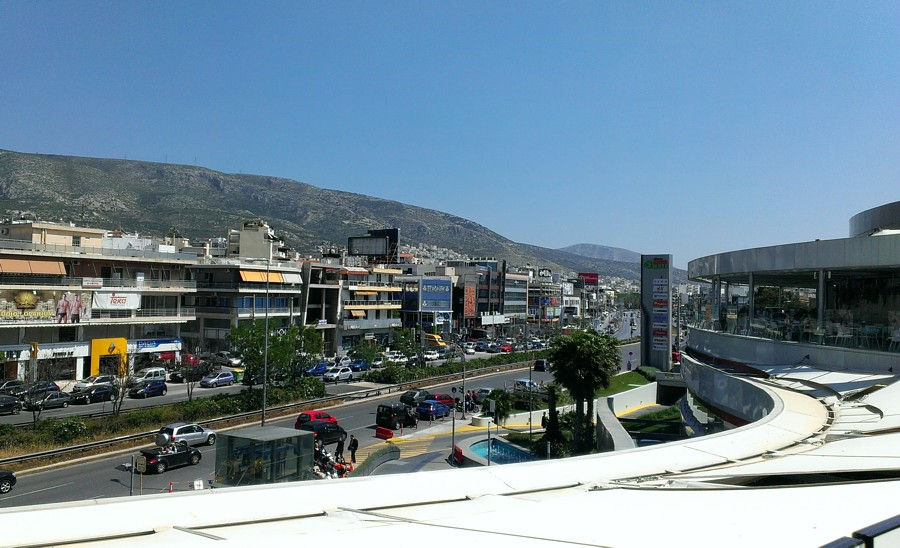
Agios Dimitrios occupies the western foot of Mount Hymettus at roughly 60 m elevation. It borders Ilioupoli to the east, Nea Smyrni to the west, Dafni-Ymittos to the north, and Alimos and Palaio Faliro to the south, placing it one short step inland from the coast. The municipality is organised into approximately 16 sub-districts (synoikies), including the central area, Panagitsa, Asyrmatos, Antheon and Ipirotika, with everyday commercial life strung along Vouliagmenis Avenue and the Agiou Dimitriou high street.
The townscape is the classic dense, post-war Athenian fabric: continuous blocks of mid-rise apartment buildings at high density, built out during the city's southward expansion. Green and open space is therefore scarce and prized. The signature asset is the Asyrmatos hill (around 78 stremmata, roughly 7.8 hectares), designated since 2016 for green, cultural and athletic use, alongside the Pikrodafni Stream, one of only about 13 open watercourses remaining in Attica.
Two area figures appear across sources and we report both honestly: the municipal area is cited as either 4.949 km2 (English Wikipedia) or about 5.364 km2 (5,364 stremmata, municipal site), which moves the density calculation between roughly 14,340 and 14,480 residents per km2. The discrepancy likely reflects administrative-boundary versus built-area measurement; either way, the conclusion is the same: this is one of the most intensively occupied urban grids in the country, and well above the South Athens regional-unit average of around 7,630 residents per km2.

Demographics & Community
The 2021 ELSTAT permanent population is 71,664 (the municipal city-profile page cites a near-identical 71,747), while the municipality estimates the real daytime population exceeds about 85,000 once commuters, workers and visitors are counted. The long-term trend is one of steady twentieth-century growth that has now plateaued: 51,421 in 1981, 57,574 in 1991, 65,173 in 2001, roughly 70,200-71,300 in 2011, and 71,664 in 2021. Growth was strongest between 1981 and 2001 and has been essentially flat over the last decade, the signature of a mature, fully built-out suburb.
Socioeconomically, this is a working- and middle-class residential community. The local economy rests on craftsmanship, small-scale manufacturing, retail and services, concentrated along Vouliagmenis Avenue and the main arteries. No municipal-level age breakdown is published; nationally the 2021 census shows Greece skewing older (22.6% aged 65+, 14.1% aged 0-14), and living guides describe Agios Dimitrios as a family-oriented, multi-generational and notably walkable neighbourhood.
One demand signal is worth noting with appropriate caution: a market source reports the average age of new residents in Agios Dimitrios fell from 42.7 in 2018 to 36.4 in 2023, suggesting a tilt toward younger professionals choosing it as an affordable, metro-served alternative to coastal and central districts. Expat presence is modest. International Golden Visa buyers would sit as a minority among Greek owner-occupiers and renters, which is precisely the value proposition: authentic, liquid local demand rather than a tourist-let monoculture.
History & Identity: From Brachami to Saint Demetrios and Panagoulis
The district carries two layers in its name. For centuries the area was known as Brachami (Mprachami), inherited from the Ottoman period when these Attic fields formed the chiflik (agricultural estate) of Braham Pasha, just as the neighbouring coastal zone was once called Hassani after Hassan Pasha. As a village grew, it clustered around the Orthodox Church of Agios Dimitrios, built in 1895-1897, and the saint eventually gave the settlement its modern name.
The administrative history is layered. A Community of Brachami was split from the Municipality of Athens in 1925 and renamed the Community of Agios Dimitrios in 1928. It first gained municipal status in 1942 (seated at Dafni), separated again as its own community in 1947, and finally became the standalone Municipality of Agios Dimitrios on 15 March 1963, a status confirmed under the 2010 Kallikratis reform. Like much of southern Athens, the area sits within the geography of the 1922 Asia Minor refugee resettlement, of which its Asyrmatos neighbourhood is a relic.
The area's strongest national-memory anchor is its metro station, officially Agios Dimitrios-Alexandros Panagoulis. It honours Alexandros Panagoulis (1939-1976), the poet and resistance figure who attempted to assassinate junta dictator Georgios Papadopoulos in 1968, was tortured and sentenced to death, and after democracy's restoration was elected to parliament. He was killed in a car crash on Vouliagmenis Avenue near this spot on 1 May 1976, widely suspected to have been an assassination. Together, the saint's church, the lingering Brachami folk name and the Panagoulis memorial give the district a distinct civic identity.

Transport & Connectivity: Metro Line 2 at the Core
The district's anchor is the Agios Dimitrios-Alexandros Panagoulis station on Metro Line 2 (the Red Line), fully underground beneath Vouliagmenis Avenue, with four street exits and a direct connection into the Athens Metro Mall. The station opened on 5 June 2004 and served as Line 2's southern terminus until the 5.5 km Elliniko extension (adding Ilioupoli, Alimos, Argyroupoli and Elliniko) opened on 26 July 2013. It is important to be precise: Agios Dimitrios is not a midpoint between Elliniko and Syntagma; it sits about six stops north of Syntagma and four stops north of Elliniko.
Travel times are the headline. The metro reaches Syntagma in approximately 11-13 minutes (no single official station-pair figure is published; the operator's official Elliniko-to-Syntagma time is 14 minutes, and Agios Dimitrios is closer). Southbound, Elliniko, the gateway to The Ellinikon, is roughly 5-7 minutes away across four stops on the same line, with no transfer. Peak headways run about 3-6 minutes and the full line takes around 35 minutes end to end.
Onward connectivity is practical rather than seamless, and we are careful not to overstate it. Vouliagmenis Avenue links the district to the Athenian Riviera and ties into the Hymettus Ring of the Attiki Odos motorway. The 24-hour X97 express bus connects directly to Athens International Airport in about 45 minutes. By road the airport is roughly 30-34 km (around 30-40 minutes off-peak) and Piraeus port roughly 8-10 km and 30-40 minutes. Note that neither the airport (served by Line 3) nor Piraeus is a single-seat metro ride from Agios Dimitrios; both require a transfer or road transport.
Destination | Mode | Time / distance |
Syntagma (city centre) | Metro Line 2 | ~11–13 min |
Acropolis | Metro Line 2 | ~15 min |
Elliniko / The Ellinikon | Metro Line 2 (4 stops) | ~5–7 min |
Athens Airport | X97 express bus | ~45 min |
Piraeus port | Road | ~8–10 km, 30–40 min |
Alimos coast & marina | Road | short drive |
The Residential Market: Prices, Rents, Yields and Trend
Read the price data in two layers. Across all existing stock, the average asking sale price was about €3,030/m2 in May 2025 (Indomio/Spitogatos), up 3.31% year on year from €2,933/m2, with neighbourhood asking prices ranging from roughly €2,429/m2 (Nekrotafeio Kallitheas) to €3,280/m2 (Monastirio, which rose further to €3,464/m2 by January 2026). The newer, higher-quality segment, the right reference for new-build Golden Visa units, was reported at approximately €4,238/m2 in Q2 2025. This roughly €3,000-versus-€4,200 spread is the single most important nuance for a buyer. All neighbourhood-level figures are asking prices from listing portals; registered transaction prices typically run somewhat below asking.
A critical clarification: do not equate Agios Dimitrios with the broader South Athens aggregate. The regional figure of around €4,091-4,125/m2 is inflated roughly 30% by the coastal riviera (Glyfada, Voula and Vouliagmeni at €5,000-7,500/m2) and is not representative of this inland municipality. Agios Dimitrios sits about 26% below its own sector average, which is precisely why buyers priced out of the coast rotate into it.
Average asking rent was about €9.53/m2/month in May 2025 (up 1.60% year on year), roughly €667 for a typical 70 m2 apartment, and materially below the coastal-inclusive sector figure of €12.50-13.10. On asking prices this implies a gross yield near 3.8%; consultancy and portal estimates of 4.5-5.2% gross (about 3.8% net) likely reflect transaction prices, which run below asking, and smaller or renovated units. We present the defensible band as 3.8-5% gross. Supporting the appreciation story: constrained Attica permit supply (down 12.6% year on year in the first eight months of 2025) and an active new-build pipeline, including a 37-unit project priced €250,000-€420,000 targeted for completion in December 2026.
The Ellinikon Regeneration & Its Spillover
The Ellinikon is the redevelopment of Athens' former international airport, about 8 km southwest of the centre, into what is marketed as Europe's largest urban-regeneration and waterfront project: roughly 6.2 million m2 (about three times Monaco), with a headline total investment of more than €8 billion (some sources cite €8.5 billion) across the full multi-decade build-out. A crucial correction: the often-quoted €2.3 billion is only the developer's near-term capital programme through 2028, a subset of the total, not the project cost. Momentum is measurable: by December 2025 secured revenues reached €2.2 billion, with around €1.6 billion of 2025 receipts.
The components are substantial. The 200 m, roughly 50-floor Riviera Tower (Foster + Partners; Greece's first skyscraper, around 170-173 residences, reported fully pre-sold) had reached its upper floors by early 2026. The roughly 263-hectare Metropolitan Park will rival Hyde Park, with a first coastal sports section of about 287,000 m2 due to open to the public by mid-2026. Retail follows with the Riviera Galleria (around 100 stores, opening expected mid-2027) and the Ellinikon Mall (around 350 stores, expected around 2028), plus the Hard Rock Hotel & Casino integrated resort and the expanding Agios Kosmas marina. Projections cite roughly 75,000-85,000 jobs and a contribution of about 2.4-2.5 percentage points to Greek GDP; these are forecasts, not realised outcomes.
The relevance to Agios Dimitrios is direct. The district sits four stops north of Elliniko on the same Line 2, a 5-7 minute ride from the megaproject without coastal pricing. The spillover is documented: South Athens new-build prices have risen by double-digit percentages, with the strongest growth in Elliniko, Glyfada and Vari, and January 2025 new-build averages near €5,039/m2 in Elliniko and €7,441/m2 in Vouliagmeni. Critically for a buyer, market reports note demand explicitly flowing into the more affordable inland stops, Alimos and Argyroupoli, the very stations between Agios Dimitrios and Elliniko, positioning the district as a value-entry point on the same corridor benefiting from the Ellinikon halo. These price percentages are directional market commentary, not official indices.
Lifestyle & Amenities
Agios Dimitrios offers the comprehensive, walkable amenity base of a genuine neighbourhood rather than a holiday-let address. Education provision is unusually deep for a district this size: the municipality lists 21 numbered public primary schools plus a special primary school, supported by gymnasia and lyceia. Its architectural landmark is the Strongylo (Round) secondary school by Takis Zenetos, built 1970-1976, a radial design serving roughly 1,500 students. Note that no large dedicated English-language international school sits inside the municipality itself; international families typically rely on schools across the wider South Athens belt.
Everyday healthcare runs through three municipal clinics (Thessalias 10, Roumeli 21, Olympou 36) covering internal medicine, orthopedics, gynecology, pulmonology and cardiology, plus two physiotherapy centres. There is no general hospital inside the municipality; serious care is at major public hospitals in the wider area, such as Asklepieion Voulas to the south and central teaching hospitals reached via the metro. The signature green and recreation space is the Asyrmatos / Eleftherios Venizelos hill park (about 7.8 hectares), whose unified renovation contract was signed in May 2025, alongside a municipal stadium, courts, a gym and a swimming pool.
Retail and daily life centre on the Athens Metro Mall, directly atop the metro station, with roughly 80-90 stores over five levels, about 18 dining outlets, a cinema, a supermarket and 1,200 parking spaces. A strong street-market culture adds five weekly laiki agora across the neighbourhoods. The municipality is consistently grouped with Ilioupoli, Alimos and Nea Smyrni as a safer, family-suitable South Athens choice, and its UN-recognised Sustainable Development Goals Voluntary Local Review (2023) and CIVITAS mobility participation reinforce a quietly improving, well-governed livability picture.
Athens Metro Mall: ~80-90 stores, ~18 dining outlets, cinema, supermarket, 1,200 parking spaces, atop the metro station
21 public primary schools plus the landmark Strongylo (Round) secondary school by Takis Zenetos (1970-1976)
Three municipal clinics plus two physiotherapy centres; major hospitals in the wider South Athens area
Asyrmatos / Eleftherios Venizelos hill park (~7.8 ha) with playground, courts, football field and trails
Five weekly farmers' markets (laiki agora): Mon Lidoriki; Wed Brachami & Kopsachila; Fri Asyrmatos & Antheon

The Golden Visa Framework & How Agios Dimitrios Fits
Greece's Golden Visa is anchored in the Migration Code (Law 5038/2023, Article 100, in force from 1 January 2024) and was overhauled by Law 5100/2024, which introduced a three-zone structure for transactions from 1 September 2024. The thresholds are: €800,000 for high-demand Zone A (the entire Region of Attica, including Athens, Piraeus and the South Athens sector, plus the Thessaloniki regional unit and islands over 3,100 inhabitants); €400,000 for the rest of Greece; and a reduced €250,000 for two special routes only. The two higher tiers require a single property of at least 120 m2 main living area, and combining smaller units is prohibited.
This is decisive for Agios Dimitrios. As a South Athens municipality inside Attica, it is firmly in the €800,000 Zone A tier for a standard residential purchase; it cannot qualify at €400,000. The route that keeps the district accessible at the lowest threshold is the €250,000 change of use (αλλαγή χρήσης) conversion, converting a commercial or non-residential property to residential. This route is available nationwide independently of the zone map but is subject to local feasibility, and it is confirmed to apply in Attica. The alternative €250,000 route is full restoration of a listed or heritage building. For both, the conversion or restoration must be completed before the application is submitted.
The terms are favourable and well documented. The location tiering does not bind the €250,000 routes; the 120 m2 minimum is documented as not applying to them, though some sources suggest the 120 m2 floor may still apply to conversions, so verify against the latest guidance (the November 2025 Ministerial Decision 214926/2025 standardised proof via an engineer's technical report). Golden Visa properties cannot be let short-term, on penalty of revocation and a fine up to €50,000. The permit is an initial five years, renewable indefinitely while the property is held, with no minimum stay, Schengen free movement, family inclusion (spouse, children up to 21, dependent parents of both spouses) and a path to citizenship after seven years. The statute requires issuance within two months of a complete file; in practice, post-2025 decentralisation, well-prepared files clear in around three months.
Zone A standard purchase: €800,000 minimum, single property at least 120 m2 (Agios Dimitrios falls here)
€250,000 route 1: change of use (αλλαγή χρήσης) converting commercial/non-residential to residential, completed before applying
€250,000 route 2: full restoration of a listed or heritage building
Single-property rule; short-term rental banned (revocation plus fine up to €50,000)
Permit: 5 years renewable, no minimum stay, Schengen travel, family inclusion, citizenship path after 7 years
The Investment Thesis & Comparables
The core argument is a structural value gap on a single axis: connectivity-adjusted price. Agios Dimitrios trades near €3,030/m2 while sitting on Metro Line 2, roughly 11-13 minutes from Syntagma in one direction and a 5-7 minute ride to Elliniko and the Riviera in the other. That same corridor's destinations cost far more: Vouliagmeni around €7,586/m2, Elliniko around €5,300/m2 and Alimos centre around €5,364/m2, and the Ellinikon flagship €8,500-13,700/m2. On those figures Agios Dimitrios is roughly 60% below Vouliagmeni, about 43% below Elliniko and Alimos, and around 64% below the adjacent flagship development. The investor buys the same arterial and metro line at a meaningful discount, betting the spillover narrows the gap.
Against its true peer set, the inland-south municipalities, Agios Dimitrios is mid-pack and fairly priced: near Nea Smyrni (€3,306) and Ilioupoli (€3,268), below Argyroupoli (€3,481), above the cheapest peer Dafni (€2,696). The differentiator is momentum and a catalyst: Ilioupoli is appreciating fastest (+10.2% year on year) and is the closest read-through for what metro-served, Ellinikon-proximate inland districts can do. Agios Dimitrios shares Ilioupoli's Line 2 position but adds the Metro Mall hub at a lower entry price.
Return is two-engine: a modest but stable gross yield of roughly 3.8-5%, underpinned by a dense, liquid owner-occupier market of 71,664 residents, plus appreciation. The Bank of Greece urban dwelling index rose 7.69% year on year in Q3 2025 and Attica sale prices about 8.8%; district-level estimates (lower confidence, from a single secondary source) suggest Agios Dimitrios has compounded around 8% a year since 2021. The honest risks: yield compression as prices outpace rents; reliance on Ellinikon-spillover timing running 2026-2028; some peers (Argyroupoli) already showing year-on-year softening; a roughly 31% year-on-year fall in net foreign real-estate FDI in Q1 2025 (a national figure); and Zone A rules that make non-conversion purchases capital-intensive. The target buyer is the local Greek professional or family, making this a long-term-rental, fundamentals-driven hold rather than a short-let play.
Area | Asking price €/m² | vs Agios Dimitrios |
Agios Dimitrios | ~€3,030 | — |
Dafni (inland peer) | ~€2,696 | −11% |
Ilioupoli (inland peer) | ~€3,268 | +8% |
Nea Smyrni (inland peer) | ~€3,306 | +9% |
Argyroupoli (inland peer) | ~€3,481 | +15% |
Alimos (coastal) | ~€5,364 | +77% |
Elliniko (coastal) | ~€5,300 | +75% |
Vouliagmeni (coastal) | ~€7,586 | +150% |
Closing Outlook
Agios Dimitrios is best understood not as a destination in itself but as a disciplined position on one of southern Athens' strongest corridors. The fundamentals are durable: a dense, liquid resident base of 71,664; three Line 2 stations on and around its borders; comprehensive walkable amenities anchored by the Metro Mall; and a fixed-rail, four-stop link to a €8 billion-plus regeneration that is already transforming the coast a short ride south. The district offers the same arterial and the same metro line as its pricier neighbours, at a discount that the documented Ellinikon spillover into inland stops is positioned to narrow.
The case is appreciation-led rather than yield-led, and it rewards patience and structure. Yields are modest (roughly 3.8-5% gross) and the catalyst runs over 2026-2028, so this is a long-term, fundamentals-driven hold for a buyer who values authentic local demand over short-let speculation. The honest caveats remain: neighbourhood price growth is steady rather than spectacular (around 3.3% year on year, not the coast's double digits), some peers are already cooling, and Zone A rules mean a standard purchase here requires €800,000.
For the Golden Visa buyer, the practical conclusion is clear. A finished apartment qualifies only at the €800,000 Zone A threshold, but the €250,000 change of use (αλλαγή χρήσης) conversion route turns this well-connected, fairly priced municipality into a lowest-threshold entry point, provided the conversion is properly completed before application. That is precisely the structure Avla advises on, and it is where careful, compliant execution makes the difference.
Agios Dimitrios lets you buy the same metro line and the same avenue as the coast, at a fraction of the price. The discount is the opportunity; the Ellinikon spillover is the catalyst that may close it.
Considering a Golden Visa entry in South Athens? Avla Gayrimenkul A.S. will structure the €250,000 change-of-use route correctly, vet the property and connectivity, and guide your application end to end. Talk to your trusted partner before you commit.
Image credits — Wikimedia Commons: central square, Vouliagmenis Avenue and the Panagoulis monument by Dimorsitanos (CC BY-SA 3.0); residential street by Michalis Andreakos (CC BY-SA 4.0); boundary map by Pitichinaccio (CC BY 3.0).


Comments